
Method
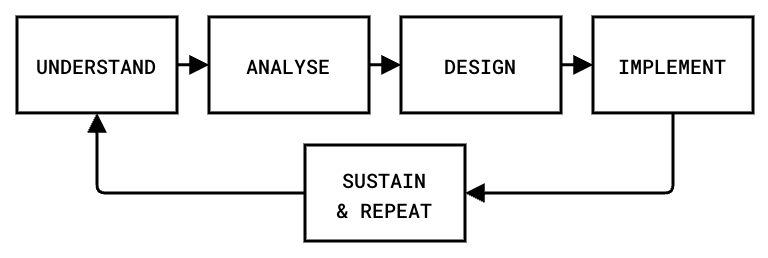
In our projects, we use a proven methodology that enables us to focus on the most important goals and deliver them reliably through an iterative process.
Method
In our projects, we use a proven methodology that enables us to focus on the most important goals and deliver them reliably through an iterative process.
Understand
Understand the organisation’s context and the relevant aspects of its mission, vision, and values. Identify stakeholders and their motivations, understand the organisation’s maturity, compliance or performance requirements. Define the project’s goals and methodology.
Analyse
Analyse, audit, or assess the organisation’s AS-IS state. Map performance levels and capacity allocation, benchmark them. Identify non-conformities and improvement opportunities, and prioritise them against the project goals.
Design
Define the TO-BE state, the desired business and technology architectures, and the changes needed to address non-conformities and improvement opportunities to achieve the project goals. Conduct simulations to estimate future performance and capacity. Obtain the organisation’s decision on the proposed changes and alternatives. Create a roadmap, secure funding and commitment.
Implement
Implement or govern the implementation of changes to business, processes, and technology. Build capacity, provide training. Align motivation and governance structures.
Sustain & repeat
Maintain delivered solutions. Audit the effects of implemented changes. Monitor new performance levels and capacity allocation. Evaluate the need for further action, and initiate the next iteration of the change process.
Understand
Understand the organisation’s context and the relevant aspects of its mission, vision, and values. Identify stakeholders and their motivations, understand the organisation’s maturity, compliance or performance requirements. Define the project’s goals and methodology.
Analyse
Analyse, audit, or assess the organisation’s AS-IS state. Map performance levels and capacity allocation, benchmark them. Identify non-conformities and improvement opportunities, and prioritise them against the project goals.
Design
Define the TO-BE state, the desired business and technology architectures, and the changes needed to address non-conformities and improvement opportunities to achieve the project goals. Conduct simulations to estimate future performance and capacity. Obtain the organisation’s decision on the proposed changes and alternatives. Create a roadmap, secure funding and commitment.
Implement
Implement or govern the implementation of changes to business, processes, and technology. Build capacity, provide training. Align motivation and governance structures.
Sustain & repeat
Maintain delivered solutions. Audit the effects of implemented changes. Monitor new performance levels and capacity allocation. Evaluate the need for further action, and initiate the next iteration of the change process.
Understand
Understand the organisation’s context and the relevant aspects of its mission, vision, and values. Identify stakeholders and their motivations, understand the organisation’s maturity, compliance or performance requirements. Define the project’s goals and methodology.
Analyse
Analyse, audit, or assess the organisation’s AS-IS state. Map performance levels and capacity allocation, benchmark them. Identify non-conformities and improvement opportunities, and prioritise them against the project goals.
Design
Define the TO-BE state, the desired business and technology architectures, and the changes needed to address non-conformities and improvement opportunities to achieve the project goals. Conduct simulations to estimate future performance and capacity. Obtain the organisation’s decision on the proposed changes and alternatives. Create a roadmap, secure funding and commitment.
Implement
Implement or govern the implementation of changes to business, processes, and technology. Build capacity, provide training. Align motivation and governance structures.
Sustain & repeat
Maintain delivered solutions. Audit the effects of implemented changes. Monitor new performance levels and capacity allocation. Evaluate the need for further action, and initiate the next iteration of the change process.